Why Do Electric Scooter Batteries Catch Fire? EV Battery Safety Tests, AIS-156 Standards and Buyer Checklist (2026 Guide)
Are you planning to buy an Electric Scooter? But worrying about the fire accidents, then this guide is for you. Electric scooters have become one of the most popular ways to commute, as they are environmentally friendly, affordable to run, and require less maintenance as compared to petrol scooters. Apart from various advantages, the buyers are concerned and raise questions like, Are electric scooters safe? How to avoid battery fires?, and more. The good news for those users or buyers is that battery technology has improved significantly over the past few years.
The Indian Government has introduced a stricter safety policy, including the AIS-156 standard, making modern electric scooters much safer than earlier models. However, battery fires are possible but they are relatively rare. Here in this guide, we’ll explain everything including fire reasons, AIS-156 battery standards, safety tests, lithium-ion batteries, practical buyer guide, and more.
Why do Electric Scooters Catch Fire?
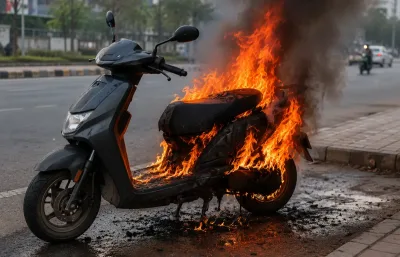
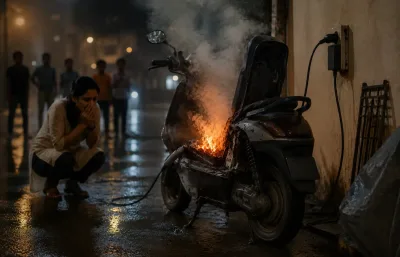
Unlike petrol scooters, EV scooters do not carry flammable fuel, instead they use high-energy lithium-ion battery packs. Electric scooter batteries catch fire due to a condition called thermal runaway, and the situation occurs when a lithium-ion battery cell becomes too hot due to an internal fault, like overcharging, exposure to excessive heat, manufacturing defects, and more. Thermal runaway is usually the final result and not the original cause.
Most of the Electric Vehicle battery fires occur because of issues like poor battery quality, damaged battery cells, water entering a compromised battery pack, a faulty Battery Management System (BMS), or the use of non-approved chargers. These factors increase battery temperature and create internal short circuits. As the temperature rises, the affected cells start releasing more heat, which spreads to nearby cells and ignites fire. Here’s in detail about the issues causing Electric Scooters fire:
1. Thermal Runaway
Thermal runaway is the biggest cause of lithium-ion battery fires. It happens when one battery cell overheats and begins generating more heat than it can safely release. This heat spreads to nearby cells, creating a chain reaction throughout the battery pack. Once thermal runaway starts, it is extremely difficult to stop.
Common triggers include internal short circuits, overcharging, physical damage, manufacturing defects, extremely high temperatures, and more. Thermal runaway typically follows these stages. The Modern battery packs of electric scooters are designed to detect this early and stop the reaction before it spreads.
2. Manufacturing Defects
Poor manufacturing quality can lead to battery failures. Examples includes, contaminated battery cells, improper welding, faulty insulation, low-quality battery materials, incorrect assembly. These hidden defects may not appear immediately but can develop into serious problems over time.
3. Poor Battery Management System (BMS)
A faulty or poorly designed Battery Management System cannot properly monitor battery health. Without proper protection, the battery may overcharge, overheat, become unbalanced, and deliver unsafe current. This significantly increases fire risk.
4. Exposure to Extreme Heat
India experiences very high summer temperatures. Parking an electric scooter under direct sunlight for long hours can increase battery temperature. Although modern batteries are designed to handle heat, prolonged exposure may accelerate battery ageing and increase stress on battery cells.
5. Overcharging
Modern scooters automatically stop charging when the battery reaches full capacity. However, problems may occur if an incompatible charger is used, the charger is damaged, or the charging system fails. Overcharging increases battery temperature and puts stress on the cells.
6. Physical Damage
Battery packs can be damaged in situations like, major accidents, deep potholes, water entering damaged battery casing, improper repairs, and more. Even if the electric scooter appears normal, internal battery damage may develop later.
7. Water Damage
Most electric scooters are designed to handle rain and water splashes. However, Flood water, Deep water crossings, Damaged battery seals, Poor repairs, can allow moisture to enter the battery pack and damage internal components.
8. Using Non-Approved Chargers
Using cheap local chargers or duplicate accessories can be dangerous. Original chargers communicate with the Battery Management System to control charging safely. A poor-quality charger may, supply incorrect voltage, cause overheating, damage battery cells, reduce battery life
How Does an EV Battery Work?
An electric scooter battery consists of hundreds or even thousands of small lithium-ion cells connected together. These cells work together to store and supply electricity. The battery pack also includes, Battery Management System (BMS), temperature sensors, cooling and protection systems, high-voltage wiring, charging control electronics, safety fuses and more which helps to prevent thermal runaway and ensures peak operating conditions.
The Battery Management System (BMS) of the battery is considered as the brain of the battery because it continuously monitors battery temperature, voltage, charging speed, cell balance, and current flow. If anything goes wrong in the batter, BMS instantly detects it and reduces the power or stops charging to protect the battery.
Everything about AIS-156
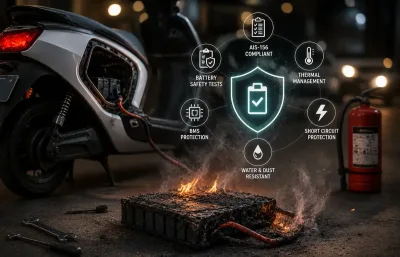
AIS-156 is one of India's battery safety standards for two wheeler electric scooters. After the removal of AIS-048, AIS-156 was introduced and it required manufacturers to make battery packs much safer by improving the factors like, battery designs, cell quality, waterproofing, crash safety, thermal protection, battery monitoring, and charging safety, The AIS-156 was introduced by the government replacing the older framework. Now any electric scooter sold in India must comply with the latest AIS-156 requirements.
The older framework AIS-048, was replaced by AIS-156, following the fires of 2021-22. The government introduced the modern and ultra-strict AIS-156 standard which focused on the following:
- Improved battery monitoring
- Stronger battery casing
- Enhanced vibration resistance
- Better software safety controls
- Better thermal management
- Battery abuse testing
- IPX7 ingress protection rating (Water protection)
EV Battery Safety Tests Under AIS-156
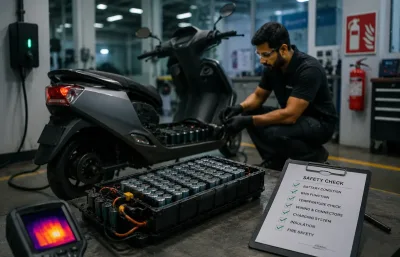
Before approval, electric scooters battery packs must undergo several rigorous safety tests, which are listed below:
- Thermal Shock Test: The battery of the electric scooter is repeatedly tested and exposed to extremely high and low temperatures according to Indian weather to ensure it performs safely in severe weather conditions, from scorching summers to colder regions.
- Mechanical Shock Test: The battery of the electric scooter is tested under sudden impacts like accidental drops, bumps, collisions, and more to evaluate its ability without suffering any internal damage.
- Vibration Test: This test is held to check the battery cells, wiring, and internal connections of the scooter. Continuous vibration is applied to the battery in the three separate spatial directions, as the scooter rides on tough roads and potholes. This test ensures that the electric scooter remains safe during regular use.
- IPX7 ingress protection rating: Battery packs are tested against water and dust to confirm they remain safe during heavy rain, water splashes, and everyday riding conditions. The battery pack is submerged in water up to 1 meter deep for 30 minutes without leaking or catching fire.
- Overcharge Test: In this test, the battery is charged beyond its recommended limit to check its ability and consequences. It is checked that the Battery Management System (BMS) works safely and stops charging before any dangerous overheating occurs.
- Over-Discharge Test: The battery is discharged below its normal operating level to ensure it remains stable and does not suffer permanent damage or safety issues.
- Fire Resistance Test: The battery is exposed to high temperatures and flames to assess its ability to resist fire and limit the spread of heat and fire to nearby cells.
- External Short Circuit Test: The team of Engineers intentionally creates an external short circuit situation to check that the battery’s protection systems immediately stops the flow of electricity and saves it from overheating and fire.
- Crush Test: The battery is compressed with significant force to check how it will react at the time of accidents. It is checked that the structure remains stable or not and avoid dangerous failures such as thermal runaway or fire.
How Battery Safety Has Improved in 2026?
With the time electric scooters are much safer because manufacturers are now more considerate and use:
- Smarter Battery Management Systems
- Improved battery cell quality
- Real-time temperature scanning
- Multiple safety sensors
- Automatic charging protection
- Better waterproof sealing
- Elimination of liquid Electrolytes
- Better battery casings
- Software updates through connected features (in some models)
- Various electric scooters monitor battery health and alerts the rider when any abnormal activity is scanned.
- Enhanced thermal insulation
Tips & Precautions to Prevent Electric Scooter Battery Fires
Most battery-related problems can be avoided with proper care and maintenance. Here are some of the simple safety tips and precautions which the electric scooter user should consider:
- Use the original OEM- approved charger provided at the time of purchasing the scooter
- Avoid charging the battery overnight or charge it after the recommendation of the manufacturer.
- Always keep the charging ports dry and clean.
- Do not charge the scooter in direct sunlight or at extreme temperature.
- Always park your scooter in shaded areas.
- Never try to open the battery pack yourself.
- If you are not riding the electric scooter for over two weeks, then store the battery at around 50-60% charge instead of keeping it empty or 100% charge.
- Timely update the scooter software.
- Do not ride through deep floodwater.
- Never charge the scooter after a long use. Always let it cool down first.
- Get the electric scooter serviced only at the authorised service center.
- Plug the charger directly into a standard wall outlet, as power strips or extension cords can lead to overheat or overload.
- If your scooter gets involved in any accident, exposed to deep water, dropped heavily or is not in a good state, then get your battery checked and do not charge it until it is fully repaired.
Electric Scooter Buyer Safety Checklist (2026)
If you are also planning to buy a new electric scooter, then this is one of the important things to consider. So before buying any electric scooter make sure it checks these important points:
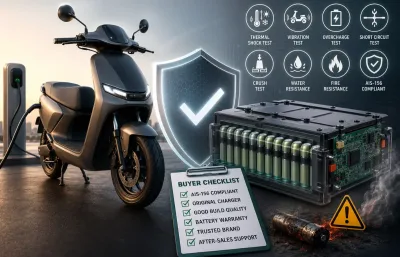
- AIS-156 Compliant Battery: Always opt for a scooter that complies with the latest AIS-156 safety standards, ensuring the battery has passed all the required strict safety and durability tests.
- Trusted Manufacturer: Always purchase the vehicle or its parts from a reputed brand with a proven safety record and a reliable service network.
- Battery Management System (BMS): A smart BMS continuously monitors battery temperature, voltage, and charging to prevent overheating and overcharging.
- Charger Cut-off System: While purchasing make sure that the charger features an automatic cut-off mechanism to prevent overcharging and any accident.
- IP-Rated Battery Protection: Look for batteries with good water and dust resistance, especially if the travel is frequent during monsoons.
- Original Charger: Make sure that your scooter comes with a genuine manufacturer-approved charger.
- Battery Warranty: A longer battery warranty provides peace of mind to the buyer and reflects the manufacturer's confidence in the product.
- Software Updates: Smart scooters that receive regular software updates can improve battery performance, safety, and overall efficiency over time.
Final Thoughts
With the demand for electric scooters, the risk of fire accidents also increased in recent times which disturbed the old users and new buyers. But today with the technology and regulations, the electric scooters are more improved and safer to use. The authorities have advanced in battery technology, improved manufacturing practices, smarter Battery Management systems, and improved AIS-156 safety standards, which decreased the risk of fire accidents.
Not only this, but the users should also consider the necessary factors before buying the electric scooter like, buying from a reputed manufacturer, selecting an AIS-156 compliant scooter, using original charger, no overcharging, and more. With these considerations, the risk of fire accidents does not vanish away but reduces. With proper maintenance and quality products, electric scooters remain one of the safest, environment friendly, and economical ways to travel in India.