Types of Electric Vehicles Explained: BEV vs PHEV vs HEV vs MHEV
Electric vehicles (EVs) are becoming increasingly popular as fuel prices rise, charging infrastructure improves, and governments encourage cleaner transportation. In India, the EV market is expanding rapidly, with more electric cars, SUVs, and hybrid models available than ever before. While researching an EV, you may come across several types of electric vehicles terms like BEV, PHEV, HEV, and MHEV. Although they all fall under the category of electric vehicles, each uses electricity differently and offers a unique driving experience.
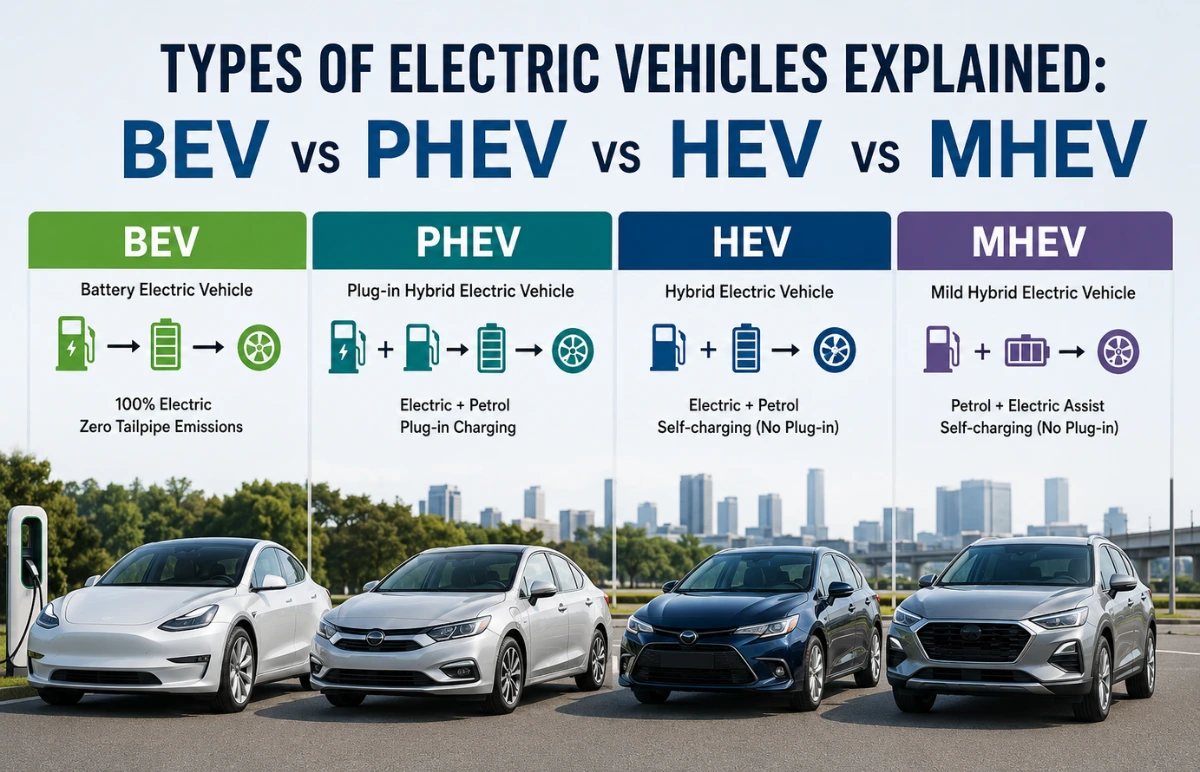
Understanding the difference between BEV vs PHEV vs HEV vs MHEV is essential before making a purchase. A BEV runs entirely on electricity, a PHEV combines electric power with a fuel engine, an HEV charges itself while driving, and an MHEV uses a small electric motor to improve fuel efficiency. This guide explains how each type of electric vehicle works, along with its advantages, disadvantages, and ideal use cases, helping you choose the right electric vehicle based on your driving needs, budget, and access to charging facilities.
Kinds of Electric Vehicles
1. Battery Electric Vehicle (BEV)
.webp)
A Battery Electric Vehicle (BEV) is a type of electric vehicle that runs entirely on electricity stored in a rechargeable battery. Unlike conventional petrol or diesel vehicles, a BEV does not have an internal combustion engine, fuel tank, or exhaust system. Instead, it uses one or more electric motors powered by a high-capacity lithium-ion battery pack. Since there is no fuel combustion, BEVs produce zero tailpipe emissions, making them the cleanest and most environmentally friendly types of electric vehicles.
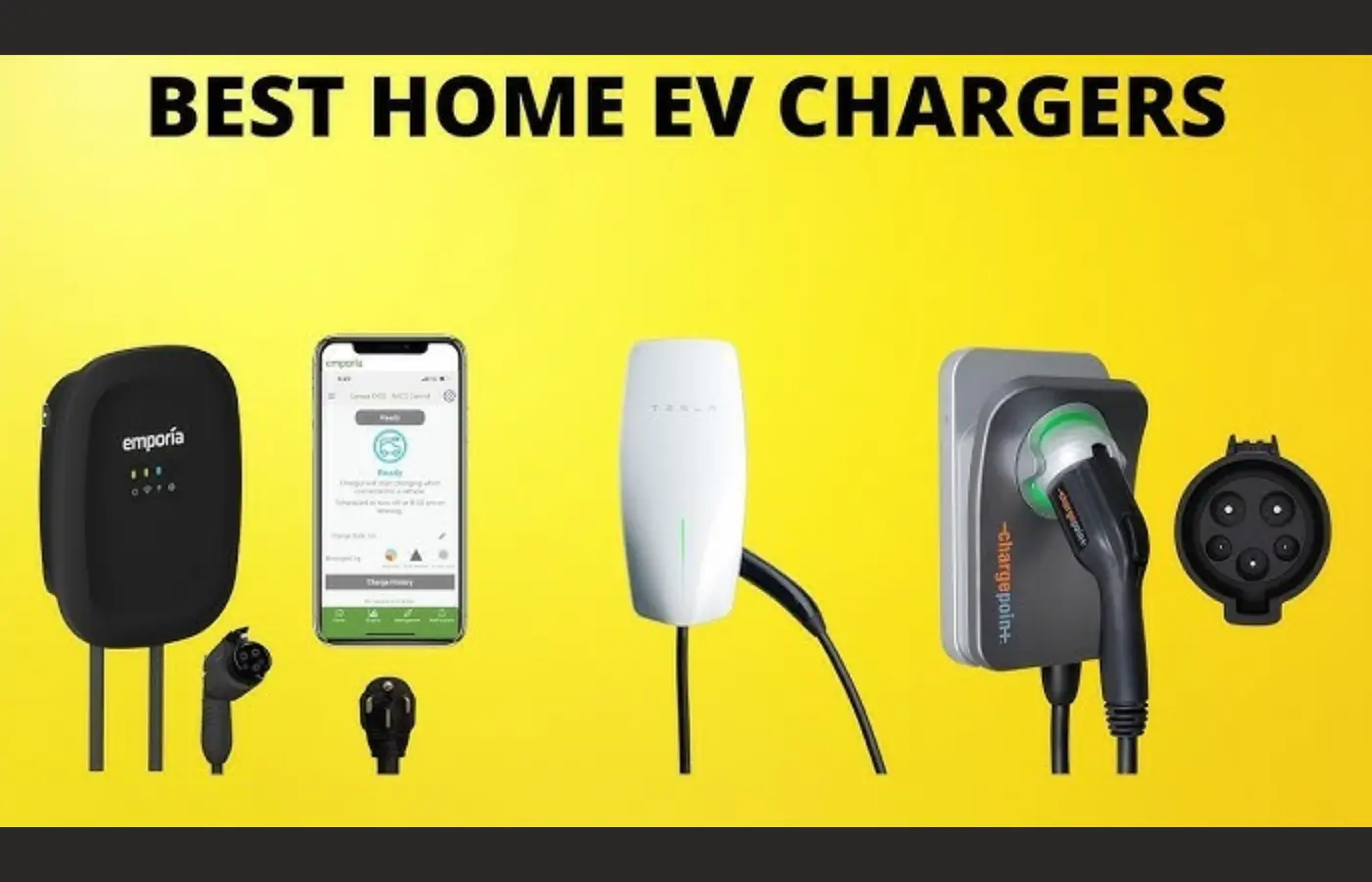
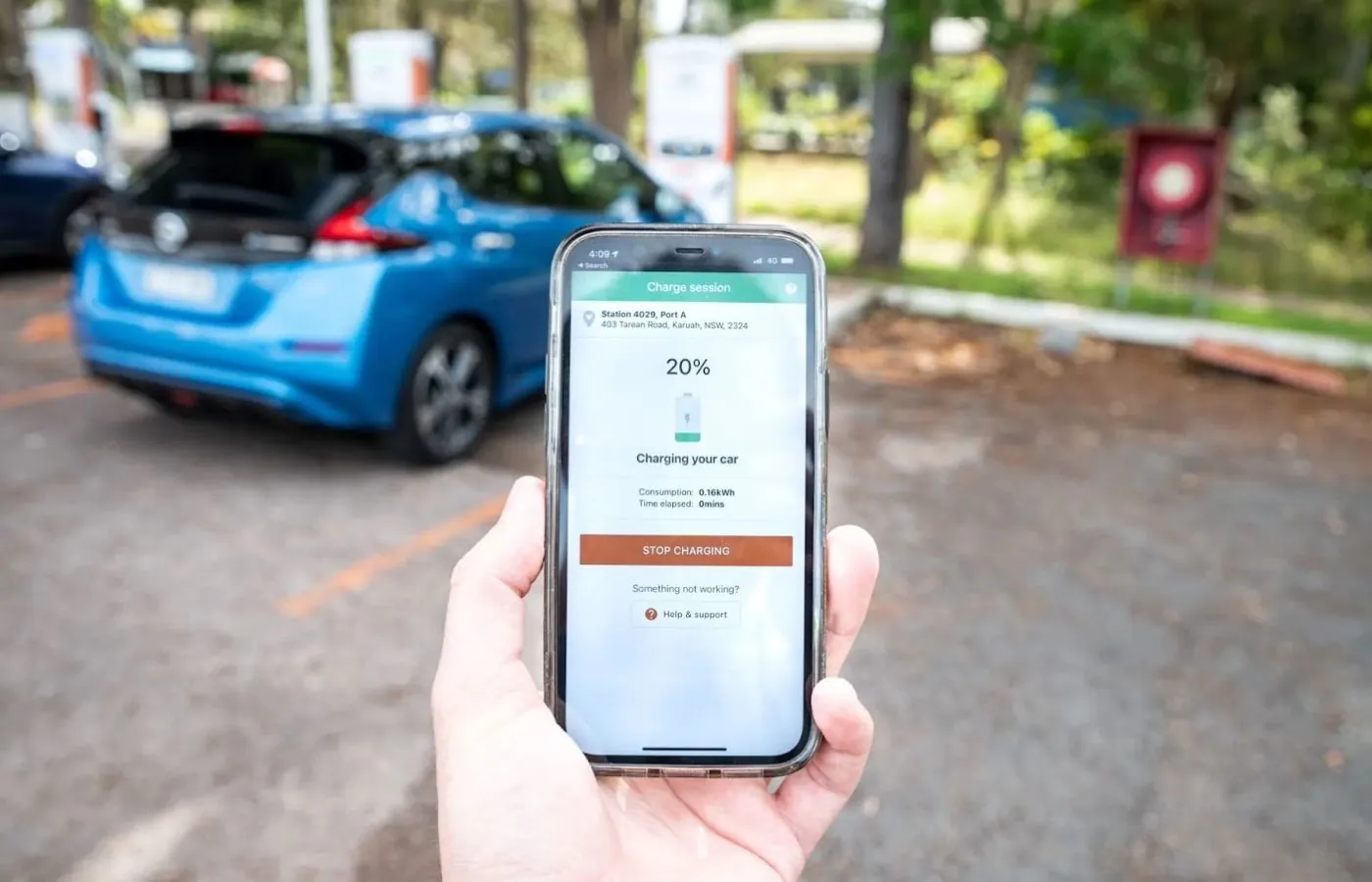
BEVs are charged using an external power source, such as a home wall charger, workplace charger, or public AC/DC charging station. Charging time depends on the battery size and charger type. While a standard AC charger may take several hours to fully charge the battery, a DC fast charger can significantly reduce charging time, making long-distance travel more convenient.
How Does a BEV Work?
The working mechanism of a BEV is simple and highly efficient. Electricity stored in the battery is supplied to the electric motor, which converts electrical energy into mechanical energy to drive the wheels. Unlike petrol-powered vehicles, BEVs have a much simpler drivetrain with fewer moving parts, resulting in lower maintenance and improved reliability.
Most BEVs also feature regenerative braking, a technology that captures energy generated during braking and sends it back to the battery. This not only improves energy efficiency but also helps extend the vehicle's driving range, especially during stop-and-go city traffic.
Advantages of BEVs
Battery Electric Vehicles offer several benefits over conventional and hybrid vehicles:
- Zero tailpipe emissions, making them environmentally friendly.
- Lower running costs, as electricity is generally cheaper than petrol or diesel.
- Minimal maintenance due to fewer mechanical components and the absence of engine oil changes.
- Smooth and quiet driving experience, with instant torque and quick acceleration.
- Government incentives such as subsidies, tax benefits, and reduced registration charges in many regions.
Limitations of BEVs
Despite their advantages, BEVs also have a few limitations:
- Charging takes longer than refuelling a conventional vehicle.
- Public charging infrastructure is still developing in many areas.
- The initial purchase price is generally higher because of battery costs.
- Long-distance travel may require careful trip planning due to charging availability, although modern BEVs now offer ranges of over 400 km on a single charge.
Who Should Buy a BEV?
A Battery Electric Vehicle is one of the types of electric vehicles which is best suited for people who drive primarily within cities or have predictable daily commutes. It is also an excellent choice for buyers who have access to home or workplace charging and want to minimise fuel and maintenance expenses. Environment-conscious consumers looking to reduce their carbon footprint will also benefit from choosing a BEV.
Popular BEVs in India
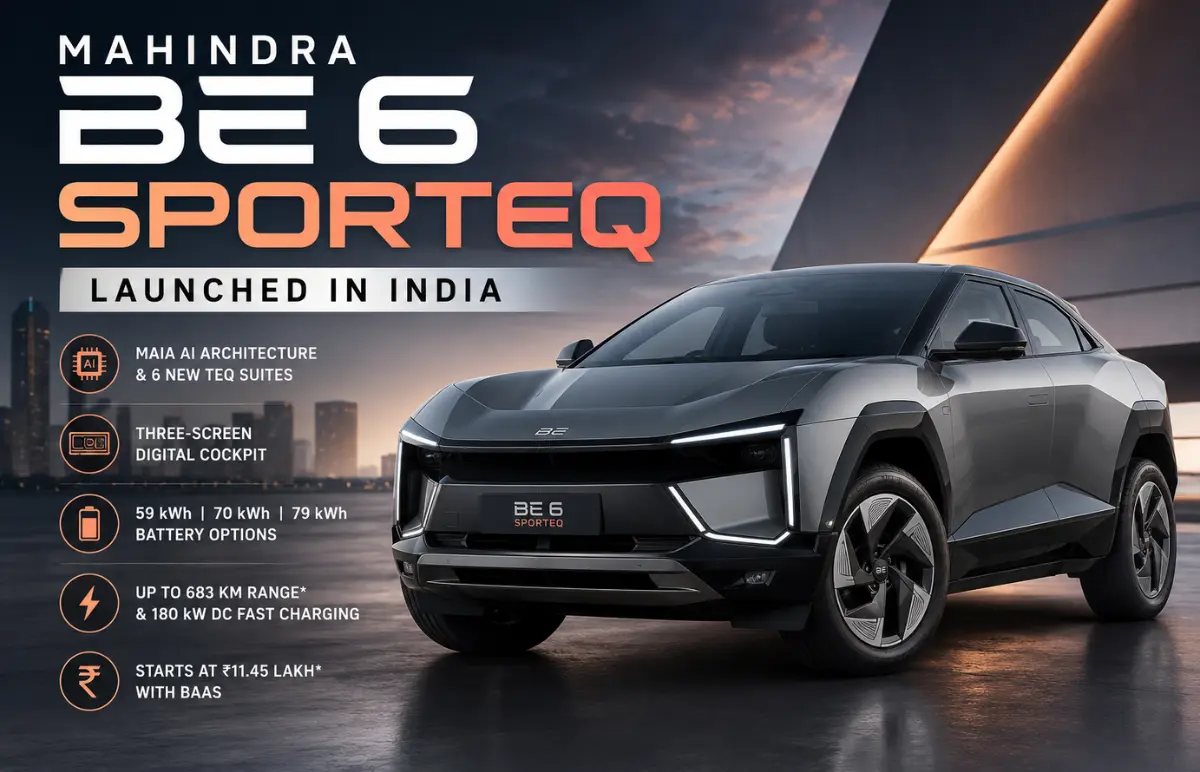
The Indian market now offers several Battery Electric Vehicles across different price segments. Some popular options include the Tata Tiago EV, Tata Punch EV, Tata Nexon EV, MG Comet EV, MG Windsor EV, Mahindra XUV400, Mahindra BE 6, Hyundai Creta Electric, BYD Atto 3, and Kia EV6. These models cater to a wide range of buyers, offering varying battery capacities, driving ranges, and features to suit different budgets and driving needs.
2. Plug-in Hybrid Electric Vehicle (PHEV)
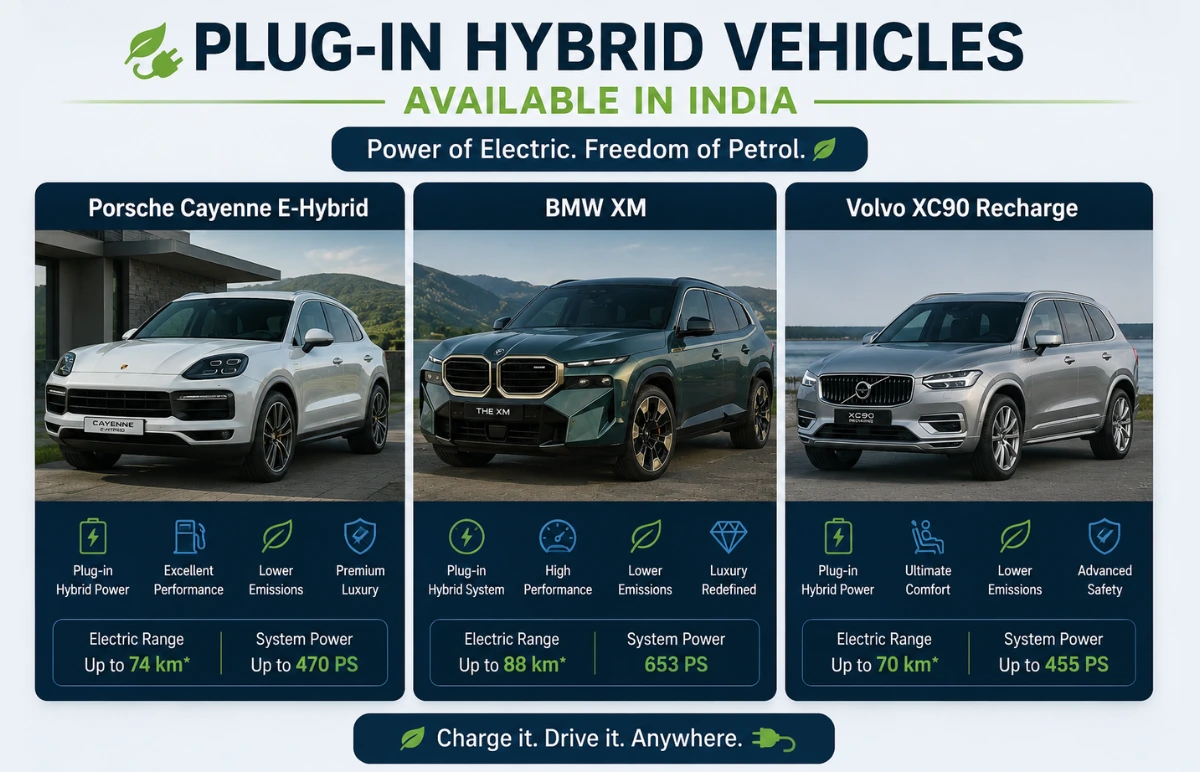
A Plug-in Hybrid Electric Vehicle (PHEV) combines an electric motor with a conventional petrol or diesel engine, offering the benefits of both electric and fuel-powered driving. Unlike a Battery Electric Vehicle (BEV), a PHEV has two power sources and can switch between them automatically depending on driving conditions. It also features a larger battery than a regular hybrid, which can be charged externally using a home charger or a public charging station.
A fully charged PHEV can typically travel 40–100 km using electricity alone, making it suitable for daily city commutes. Once the battery is depleted, the internal combustion engine takes over, allowing the vehicle to continue without requiring immediate charging. This combination eliminates range anxiety while still reducing fuel consumption and emissions.
How Does a PHEV Work?
A PHEV uses a rechargeable battery pack, an electric motor, and a petrol or diesel engine. During short trips or city driving, the vehicle primarily runs on electricity. When the battery charge falls below a certain level or extra power is needed, the engine starts automatically and works alongside the electric motor.
Like BEVs, PHEVs also use regenerative braking, which recovers energy during braking and stores it in the battery. Since the battery can also be charged externally, drivers can maximise electric driving and minimise fuel usage by charging regularly.
Advantages of PHEVs
Plug-in Hybrid Electric Vehicles offer several practical benefits:
- Can run on electricity alone for short daily commutes.
- Eliminates range anxiety with the support of a petrol or diesel engine.
- Lower fuel consumption compared to conventional vehicles.
- Reduced carbon emissions, especially in city driving.
- Suitable for both urban commuting and long-distance travel.
Limitations of PHEVs
While PHEVs offer flexibility, they also have a few drawbacks:
- Higher purchase price than conventional petrol cars.
- More complex drivetrain due to the presence of both an engine and an electric motor.
- Requires regular charging to achieve maximum fuel savings.
- Maintenance costs can be higher than BEVs because both the engine and electric system require servicing.
Who Should Buy a PHEV?
A Plug-in Hybrid Electric Vehicle is ideal for buyers who commute short distances during the week but frequently undertake long road trips. It is also suitable for people who want the benefits of electric driving without relying entirely on charging infrastructure.
Popular PHEVs
Plug-in hybrid options provided in India includes:
- Porsche Cayenne E-Hybrid
- BMW XM
- Volvo XC90 Recharge
3. Hybrid Electric Vehicle (HEV)
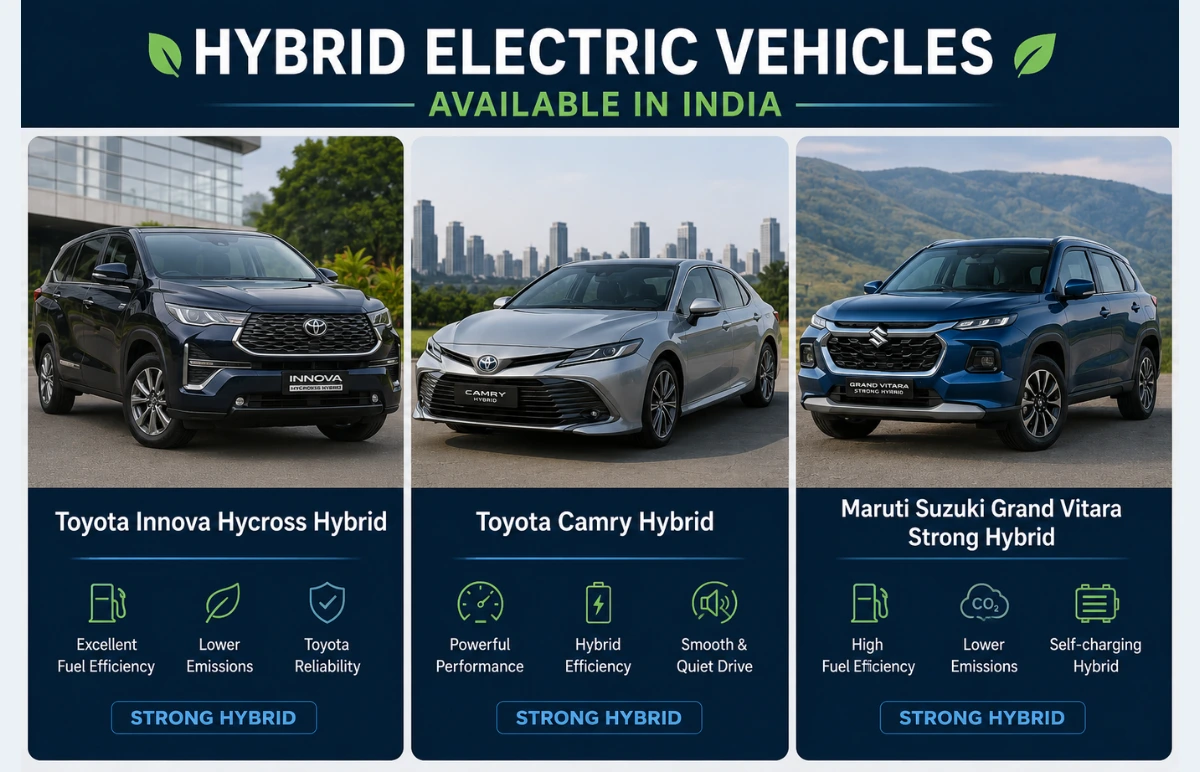
A Hybrid Electric Vehicle (HEV) is one of the types of electric vehicles which combines a petrol engine with an electric motor to improve fuel efficiency and reduce emissions. Unlike a PHEV, an HEV does not require external charging. Instead, its battery is charged automatically through regenerative braking and by the engine itself.
The vehicle intelligently switches between the petrol engine and electric motor based on speed, battery charge, and driving conditions. At low speeds, the electric motor may power the vehicle independently for short distances, while the engine provides power during acceleration and highway driving.
How Does an HEV Work?
An HEV continuously manages the balance between its petrol engine and electric motor. During slow-speed driving or traffic, the electric motor assists or temporarily powers the vehicle. As speed increases or more power is needed, the engine takes over while the electric motor continues to support it.
The battery recharges automatically whenever the vehicle slows down or brakes using regenerative braking. This means drivers never need to plug in the vehicle for charging.
Advantages of HEVs
Hybrid Electric Vehicles provide several ownership benefits:
- Better fuel economy than conventional petrol or diesel vehicles.
- No external charging required.
- Lower emissions compared to traditional vehicles.
- Smooth and quiet driving, especially in city traffic.
- Convenient ownership without depending on charging stations.
Limitations of HEVs
Despite their efficiency, HEVs have some limitations:
- Higher purchase cost than comparable petrol vehicles.
- Cannot travel long distances using electricity alone.
- Maintenance costs are slightly higher due to the hybrid system.
- Fuel savings are lower than those of fully electric vehicles.
Who Should Buy an HEV?
An HEV is an excellent choice for buyers who want improved mileage without changing their driving habits. It is particularly suitable for people living in areas where charging infrastructure is limited but who still want lower fuel consumption and emissions.
Popular HEVs in India
Some of the most popular Hybrid Electric Vehicles available in India include:
- Toyota Innova Hycross Hybrid
- Toyota Camry Hybrid
- Maruti Suzuki Grand Vitara Strong Hybrid
- Maruti Suzuki Invicto
- Honda City e:HEV
4. Mild Hybrid Electric Vehicle (MHEV)
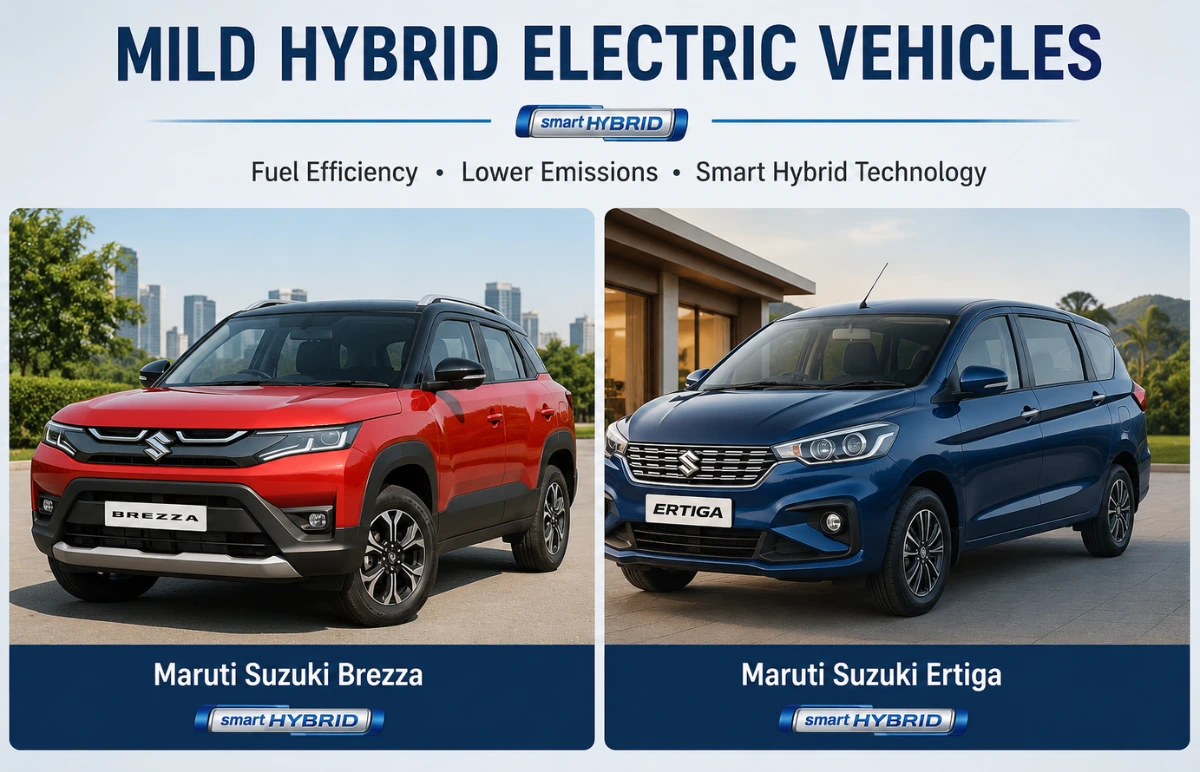
A Mild Hybrid Electric Vehicle (MHEV) is the simplest form of hybrid technology. It uses a small battery and an electric motor to assist the petrol or diesel engine during acceleration, overtaking, and start-stop operations.
However, unlike BEVs, PHEVs, or HEVs, the electric motor cannot independently power the vehicle.
How Does an MHEV Work?
The electric motor in an MHEV provides additional torque when the driver accelerates, reducing the effort required from the engine. During braking or deceleration, regenerative braking captures energy that would otherwise be lost and stores it in the battery.
The system also supports automatic engine start-stop functionality, helping save fuel during traffic signals and slow-moving city traffic.
Advantages of MHEVs
Mild Hybrid Electric Vehicles offer several practical advantages:
- Improved fuel efficiency over conventional petrol vehicles.
- Lower emissions.
- More affordable than full hybrids and electric vehicles.
- No external charging required.
- Seamless driving experience with no change in driving habits.
Limitations of MHEVs
MHEVs also have certain drawbacks:
- Cannot drive using electric power alone.
- Fuel savings are relatively modest compared to HEVs or BEVs.
- Limited environmental benefits.
- Performance improvements are minimal.
Who Should Buy an MHEV?
An MHEV is ideal for buyers looking for a conventional vehicle with slightly better fuel economy and lower emissions. It is a good option for those who are not ready to switch to a full hybrid or electric vehicle but still want some benefits of electrification.
Popular MHEVs in India
Popular Mild Hybrid Electric Vehicles available in India include:
- Maruti Suzuki Brezza
- Maruti Suzuki Ertiga
- Maruti Suzuki XL6
- Maruti Suzuki Ciaz
- Kia Carens (select variants)
These vehicles offer a balance of affordability, improved efficiency, and the convenience of conventional refuelling, making them suitable for everyday driving.
BEV vs PHEV vs HEV vs MHEV: Which Type of Electric Vehicle Should You Choose?
Choosing the right type of electric vehicle depends on your daily driving habits, budget, and access to charging infrastructure. There is no single option that suits everyone, as each type of EV is designed for different needs.
- Choose a Battery Electric Vehicle (BEV) if you mainly drive within the city, have access to home or workplace charging, and want the lowest running costs with zero tailpipe emissions.
- Choose a Plug-in Hybrid Electric Vehicle (PHEV) if you want the benefits of electric driving for daily commutes but also need the flexibility of a petrol engine for long-distance journeys.
- Choose a Hybrid Electric Vehicle (HEV) if you want better fuel efficiency without depending on charging stations. It is an excellent option for buyers transitioning from conventional petrol or diesel cars.
- Choose a Mild Hybrid Electric Vehicle (MHEV) if your priority is improved fuel economy at a lower purchase cost while maintaining the convenience of a traditional vehicle.
Before making a purchase between the types of electric vehicles, BEV vs PHEV vs HEV vs MHEV, compare factors such as driving range, charging availability, maintenance costs, running costs, and your typical travel distance.
Evaluating these aspects will help you select the electric vehicle that best fits your lifestyle and long-term ownership goals.
.webp)