V2G Technology Explained: How Your EV Can Power Your Home & Earn Money in India
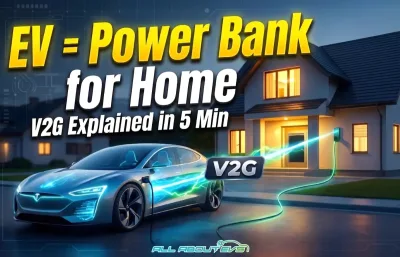
Have you ever imagined your EV car being transformed into a power generator for your electrical appliances in Home and lighting up your house using your EV's battery. Well, we at AllAboutEVs are here to explain about this technology, as it is not a fiction anymore.
This is called Vehicle-to-Grid (V2G) technology, which is a state-of-the-art innovation that powers up your home by EVs, provides support to your electricity grid and even helps you earn money.
What exactly is V2G Technology?
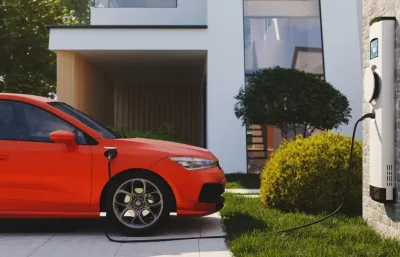
Normally, when you plug your EV to the charger, electricity flows in one way: from the grid into your car’s battery. Here, implementing V2G changes the game, as it acts like a bi-directional inverter, which ensures the DC energy stored into your EV’s battery to be converted into AC power and pushed into your home or to the public electricity grid.
For example, an average EV battery has a size of 50-100 kWh of energy stored, and a typical Indian household uses only 8-10 kWh of energy per day.
Even if you keep an additional 20-30% buffer for your commutes, your car could comfortably power up your entire house for 3-4 days. This technology is super reliable in areas where frequent electricity cuts happen, thus it is a revolutionary innovation for India.
Real-Life Savings: Reducing Electricity Bills in Half
If you are thinking about whether this is just a fantasy, it works in real-life as well. There are incredible real-life examples like Indian families bringing their home electricity bills to half using this technology.
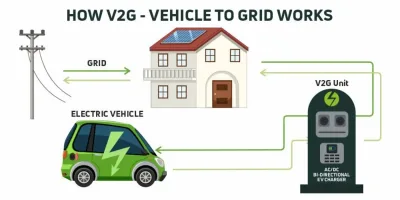
Thus seamlessly merging with grid operators, a V2G-equipped car can smartly charge itself when the electricity rates are cheap and can send power to your house especially when the demand is high, allowing you to bridge the gap.
Many global trials are conducted on this technology, such as the Octopus Energy in the UK, where it is clearly seen that participants have transferred lots of energy during peak hours.
The Three Types of Bi-Directional Charging
|
Technology |
How It Works |
Example Use Case |
|
Vehicle-to-Load (V2L) |
It connects direct appliances into the car via built-in socket. |
Connecting Camping Gear, Laptop, and Emergency Charging another EV (Eg Hyundai Ioniq 5). |
|
Vehicle-to-Home (V2H) |
Plugs the EV directly to your home’s electrical system. |
Powering your house during blackouts without being dependent on the public grid. |
|
Vehicle-To-Grid (V2G) |
It seamlessly connects with the local grid to smartly buy and sell electricity. |
Selling Excess power back to the public grid for commercial profits. |
The Future of V2G in India
However, there are various challenges to overcome right now like hardware compatibility, battery degradation concerns, and unclear electricity costs. The future is definitely promising for V2G technology in India. The seamless integration of rooftop solar panels and V2G Bi-Directional charging is emerging as a smart yet sensible solution for Indian household.
Soon after the widespread adoption of V2G technology, millions of EVs won’t just be vehicles used for mobility but instead can be transformed into a power generator providing electricity to your home and fundamentally generate, store and use the energy intelligently.